|
What Social Benefits Are Available in Japan? A Guide for Foreign ResidentsWhat Social Benefits Are Available in Japan? A Complete Guide for Foreign Residents
Japan has a broad social protection system covering healthcare, pensions, childbirth, childcare, education, employment, housing and long-term care. Foreign nationals who legally reside in Japan may use many of the same insurance programs and public services as Japanese residents once they have registered their address, enrolled in the appropriate insurance system and met the requirements of each program. However, Japanese social benefits are not a free package automatically attached to a visa. Each program separately examines factors such as residence status, municipality, insurance history, contribution period, income, age and household composition. Some benefits are financed through contributions paid by workers and employers, some are funded by national or local government, and others are limited to households meeting specific income and asset tests. This guide explains the structure of Japan's social security system and the main programs foreign residents should know, including health insurance, pensions, childbirth and childcare assistance, education support, unemployment insurance, housing assistance and the different issues relevant to each visa category.
|

| Item | National Pension | Employees' Pension Insurance |
|---|---|---|
| Main participants | Self-employed people, students and unemployed residents | Employees, public employees and eligible company officers |
| Premium | A nationally determined amount adjusted by fiscal year | Calculated from salary and bonuses |
| Cost | Generally paid by the individual | Generally shared by the employee and employer |
| Future pension | Mainly based on contribution months | Based on insured earnings and participation period |
| Spouse arrangement | No ordinary dependant arrangement | An eligible dependent spouse may become a Category 3 insured person |
At least ten years of qualifying coverage are generally required for the Old-Age Basic Pension. Under a social security agreement, qualifying periods in another country may sometimes be totalized to establish entitlement, although each country normally pays according to the periods covered under its own system.
Low-income, unemployed and student residents may apply for a contribution exemption, deferment or student special payment arrangement. Simply stopping payment without approval may reduce the future old-age pension and jeopardize disability or survivor protection.
A non-Japanese national who leaves Japan, loses pension coverage, no longer has an address in Japan, satisfies the minimum contribution requirement and has not qualified for an old-age pension may apply for a Lump-Sum Withdrawal Payment within the prescribed period. It is not a full refund of all contributions. It is calculated under a statutory formula, currently using up to a specified maximum coverage period, generally 60 months. Once paid, the related coverage period can no longer be used for a future Japanese pension, so the effect on a social security agreement or a possible return to Japan should be considered carefully.
Additional retirement options may include corporate pensions, the National Pension Fund and iDeCo, depending on employment and status.
Part 4: Child and Family Benefits
Japan supports families through cash benefits, medical subsidies, childcare services and family consultation. Eligible long-term foreign residents may generally apply under the same program rules.
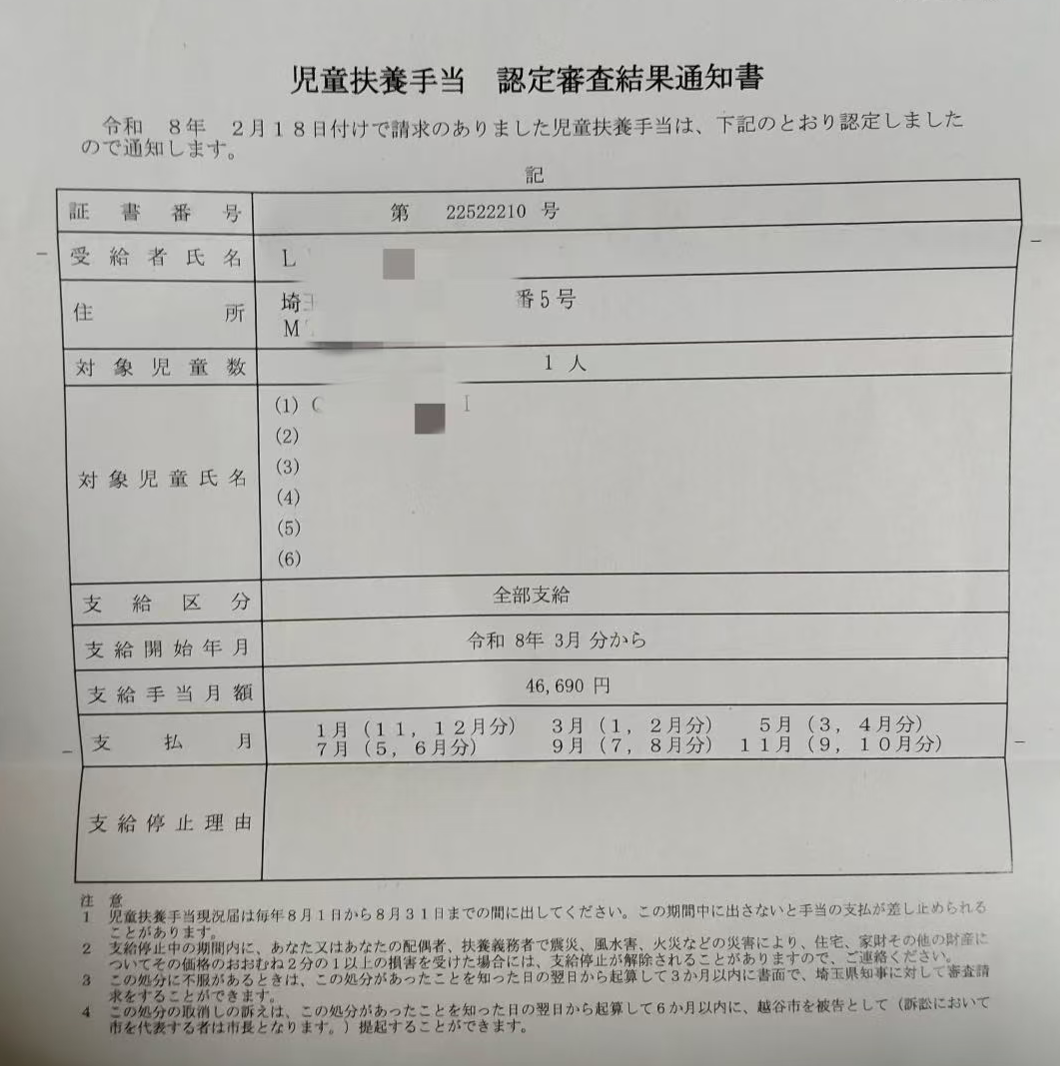
Child Allowance
The national Child Allowance generally covers children through high-school age. The current basic monthly amounts are:
Under age three: JPY 15,000 per child;
Age three through high-school age: JPY 10,000 for the first and second child;
Third and subsequent children: JPY 30,000 when the statutory counting rules are met.
The ordinary income restriction has been removed, and payments are generally made in even-numbered months for the previous two months. Older financially supported children may be relevant when determining third-child status, and they must be reported as required by the municipality.
Children must generally reside in Japan. Limited exceptions may apply to qualifying overseas study.
Single-parent and disability-related support
Child Rearing Allowance: Primarily for qualifying single-parent households or cases involving a parent with a legally defined serious disability. The amount depends on income and the number of children.
Special Child Rearing Allowance: For guardians raising a child with a qualifying moderate or severe disability, subject to income and other requirements.
Local single-parent support: Municipalities may provide medical subsidies, vocational training, qualification support and welfare loans.
Child medical subsidies
Public health insurance normally leaves a patient contribution, but municipalities commonly reduce children's insured medical costs through a child medical certificate. The age limit, small co-payment, inpatient meal treatment and income conditions vary locally, and a new application is generally required after moving.
Childcare services
Municipal services may include prenatal classes, home visits, childcare consultation, temporary care, extended-hours care, sick-child care, family support centers and local childcare support passes. Availability, fees and capacity vary by municipality.
Part 5: Pregnancy, Childbirth and Parental Support
Pregnancy notification and Maternal and Child Health Handbook
After pregnancy is confirmed, the resident should submit a pregnancy notification to the municipality and receive the Maternal and Child Health Handbook and prenatal examination subsidy vouchers. The handbook records pregnancy examinations, childbirth, child development, health checks and vaccinations. Foreign-language editions are available in some areas.
Prenatal examinations are not universally unlimited or completely free. The number of subsidized visits, covered items and values are set locally. Vouchers may need to be replaced after moving to another municipality.
Childbirth and Childcare Lump-Sum Grant
An eligible participant in public health insurance may generally receive approximately JPY 500,000 per child. Miscarriage or stillbirth after the prescribed stage of pregnancy may also qualify.
Many hospitals use a direct payment system under which the insurer pays the institution. The family pays any excess above the benefit amount; where the actual cost is lower, the balance may be claimed under the applicable procedure.
Support Benefit for Pregnant Women
Japan's current framework combines pregnancy recognition, confirmation of the number of fetuses and consultation support. The general model provides JPY 50,000 after pregnancy recognition and a further JPY 50,000 per fetus. Timing, interviews and payment methods are administered by the municipality.
Maternity leave, childcare leave and income benefits
An eligible female employee may receive a maternity allowance from Employees' Health Insurance during statutory maternity leave. Parents covered by employment insurance may qualify for childcare leave benefits.
The general childcare leave benefit rate is approximately 67% of pre-leave wages for the first 180 days and approximately 50% thereafter. Since 2025, an additional benefit may apply for a limited post-birth period when the qualifying parental leave conditions are met. A qualifying worker who reduces working hours to care for a child under age two may also receive a reduced-hours childcare benefit.
Company officers, persons not covered by employment insurance and workers without the required insurance period may not qualify for employment-insurance childcare leave benefits.
Main procedures after birth
Families generally need to:
File the birth notification within the required period;
Complete resident registration and immigration procedures for a foreign child;
Add the child to a parent's health insurance or National Health Insurance;
Apply for the child medical certificate;
Apply for Child Allowance;
Submit the birth contact form and receive the newborn home visit; and
Attend scheduled infant health examinations and vaccinations.
Hospitals, municipalities and immigration authorities should be consulted before delivery because deadlines and documents differ by procedure.
Part 6: Childcare, Compulsory Education and Student Support
Free early childhood education and care
Basic user fees for qualifying kindergartens, nursery schools and certified centers are generally covered for children aged three to five. Private kindergartens outside the new system normally receive support up to JPY 25,700 per month.
Children aged three to five with a certified childcare need who use qualifying unlicensed childcare, temporary care or sick-child care may receive support up to JPY 37,000 per month. Children aged zero to two in resident-tax-exempt households may qualify for support up to JPY 42,000 per month for eligible services.
Transport, uniforms, activities, learning materials and some meal charges generally remain payable by the family. Low-income and qualifying multi-child households may receive supplementary meal-fee relief.
Public elementary and junior high school
Japan provides nine years of compulsory education at public elementary and junior high schools without tuition or textbook charges. Families may still pay for meals, uniforms, supplies, activities and school trips.
Low-income households may apply for School Attendance Assistance covering items such as school meals, supplies, activities and school-entry preparation. Parents of foreign children generally need to apply to the local board of education or municipality for public school enrollment.
High school and higher education
High-school tuition support and local fee-reduction programs are available, with different rules for public and private schools. Universities, junior colleges and vocational schools may offer scholarships and tuition reductions based on status, household income, academic performance and institutional rules.
Higher-education support for low-income and multi-child households has nationality and residence-status conditions and should not be assumed to cover every privately financed international student. International students should search for programs expressly open to foreign students, including government scholarships, learning incentives, institutional tuition reductions and private-foundation awards.
Learning support for foreign children
Schools, international associations and nonprofit groups in some areas offer Japanese lessons, homework support, entrance-examination guidance, parent consultation and supervised activity spaces. Conversational Japanese does not necessarily mean a child can understand academic content, so early learning support can be important.

Part 7: Employment Insurance, Unemployment and Job Support
Employment insurance coverage
Employees meeting the working-hour and expected-employment requirements must generally be enrolled in employment insurance. It supports unemployment, childcare leave, family-care leave, vocational training and reemployment.
Directors and company officers are generally excluded unless they also have a genuine employee role and are individually recognized as insured workers.
Basic unemployment benefit requirements
An applicant generally must be unemployed, able and willing to work immediately, registered as a job seeker with Hello Work and have the required insurance history.
An ordinary claimant generally needs 12 insured months during the two years before separation. A person affected by bankruptcy, dismissal or another qualifying reason may be eligible with six insured months during the preceding year.
The application commonly requires the separation notices, identity and My Number evidence, and a bank account in the applicant's name. A seven-day waiting period applies, and claimants must attend unemployment certification, document job-search activity and report temporary work and earnings.
For ordinary voluntary separations occurring from April 2025, the benefit restriction after the waiting period is generally one month. A longer restriction may apply after repeated voluntary separations or dismissal for serious personal misconduct. The benefit amount is calculated from previous wages, age and statutory limits, while the payment period depends on the reason for separation, age and coverage history.
Immigration issues after job loss
Holders of work statuses linked to an affiliated organization generally need to notify immigration within 14 days after leaving or joining an employer. The status does not automatically disappear on the day employment ends, but prolonged non-engagement in the authorized activity without a justifiable reason can create immigration risk.
Job-search registration, applications, interview invitations and training records should be retained. The new job must fall within the permitted status, or the person should confirm whether a change of status is required before starting work.
Health insurance and pension coverage must also be changed after leaving employment. Options may include voluntary continuation of former health insurance, becoming a spouse's dependant, or joining National Health Insurance. A person not immediately entering a new Employees' Pension plan must also address National Pension enrollment.
Hello Work and vocational training
Hello Work provides free job registration, referrals, resume support, interview guidance, unemployment administration and training recommendations. Some offices offer foreign-language services, and specialized foreign employment service centers operate in major cities.
Public vocational training is generally tuition-free, although materials, examinations and transport may remain payable. A low-income job seeker not receiving unemployment benefits may consult the Job Seeker Support System and, if the income, assets and attendance requirements are met, may receive training-period living and transport assistance.
Part 8: Housing Assistance and Minimum-Living Support
Housing Security Benefit
A household may consult the Housing Security Benefit when its primary livelihood provider left work or closed a business within the previous two years, or experienced an involuntary reduction in work and income equivalent to unemployment, and the household has lost or risks losing its housing.
The system examines household income, savings, rent and job-search or business-recovery activity. If approved, actual rent is generally paid for three months up to the local housing-assistance ceiling. Extensions may be approved while the conditions continue, normally up to a total of nine months.
Payment is generally made directly to the landlord or property manager. Management charges, utilities, parking and internet costs are normally outside the rent benefit.
Since 2025, a household whose income has fallen substantially and must move to lower-rent accommodation to improve its finances may also consult about qualifying relocation costs. Approval should be obtained before signing or moving.
Public assistance
Public assistance provides comprehensive living, housing, medical, care, education, childbirth and funeral assistance when a household cannot maintain the minimum standard of living after using income, assets, pensions, insurance and other available systems.
The Public Assistance Act legally applies to Japanese nationals. In administrative practice, certain foreign nationals with a stable residence basis, such as permanent residents, long-term residents, spouses of Japanese nationals, spouses of permanent residents and special permanent residents, may receive comparable assistance under administrative measures. Ordinary work, student, dependent and Specified Skilled Worker statuses should not be assumed eligible solely because they are long-term statuses. The welfare office determines treatment based on status and actual circumstances.
Anyone facing an immediate lack of food, shelter or necessary medical care should consult the welfare office or hardship-support service even if eligibility is uncertain.
Other housing support
Municipalities may offer separate rent, relocation or settlement assistance for newly married couples, families with children, single parents, low-income households, migrants or disaster victims. Employers may provide housing allowances, dormitories or leased company housing, but these are company benefits rather than nationwide statutory entitlements. Students should ask their institution about dormitories, rental guarantees, emergency grants and affiliated housing.
Part 9: Basic Eligibility Requirements for Foreign Residents
Most programs examine whether the applicant:
Holds a valid and lawful residence status;
Has completed resident registration in the municipality;
Is enrolled in the relevant health, pension or labor insurance system;
Has properly declared income and fulfilled tax and contribution obligations;
Meets the program's income, age, household, residence or contribution-period requirements; and
Submits a complete application within the deadline.
Common documents include the residence card, passport, resident record, My Number evidence, My Number health card or eligibility confirmation certificate, pension number, employment insurance certificate, taxation or tax-exemption certificate, tax payment certificate, payslips, withholding statement, bank information, lease, Maternal and Child Health Handbook and family-relationship documents.
Foreign marriage, birth and family certificates normally require Japanese translations. Name spelling should be kept consistent across the passport, residence card, bank, employer and insurance records.
Benefits usually require an application and are not automatically granted when a residence card or resident record is issued. Moving, leaving a job, marriage, divorce, childbirth, increased income and departure from Japan may also trigger reporting duties.
Lawfully receiving medical, child, childbirth, unemployment or childcare insurance benefits is not normally an adverse record. However, long-term non-payment of tax, pension or health insurance, concealed income or failure to complete immigration notifications may negatively affect status renewal, permanent residence or naturalization. A single late payment does not automatically determine the outcome; timing and the overall compliance history are considered.
Part 10: Priority Benefits by Residence Status
Business Manager and family members
Check company health insurance, Employees' Pension Insurance, childbirth, childcare and child benefits. A corporation with only one remunerated representative may still be required to enter social insurance. A representative director or ordinary officer is generally not insured for employment insurance and therefore normally cannot receive ordinary employee unemployment, childcare-leave or family-care-leave benefits. Eligible family members may apply as health insurance dependants, and an eligible spouse may become a Category 3 pension participant.
Engineer/Specialist in Humanities/International Services
Confirm enrollment in employee health insurance, Employees' Pension Insurance, employment insurance and workers' compensation. Important benefits include sickness allowance, unemployment, childcare leave, family-care leave and family support. After leaving a job, address immigration notification, health insurance and pension conversion together.
Highly Skilled Professional
Social welfare treatment is generally the same as for other insured employees. The main advantages of highly skilled status are immigration benefits, such as expanded spouse work options, qualifying parental accompaniment, priority processing and an accelerated permanent-residence pathway, rather than additional cash welfare. Income-tested assistance may not apply to higher earners.
International student
Priorities include National Health Insurance, the National Pension student special payment system, scholarships, tuition reductions, student housing and institutional support. Full-time daytime students are normally excluded from employment insurance, while work injuries during permitted part-time work remain covered by workers' compensation. Part-time work requires permission and compliance with working-hour limits.
Specified Skilled Worker
Confirm employee social insurance, employment insurance, workers' compensation and the Specified Skilled Worker (i) support plan. The accepting organization or registered support organization must provide orientation, assistance with public procedures, regular interviews and necessary job-change support. Specified Skilled Worker (i) generally does not permit new accompaniment by a spouse and children, while Specified Skilled Worker (ii) may permit them when requirements are met.
Spouse of Japanese National, Permanent Resident and Long-Term Resident
These statuses generally do not have the occupational restrictions of ordinary work statuses. Participation in social insurance and access to child, housing, single-parent, disability and senior support depend on actual employment and eligibility. Certain stable-status residents may be considered for public-assistance-equivalent support in severe hardship, subject to strict income and asset examination.
Dependent status
Determine whether the person can enter the sponsoring spouse's health insurance as a dependant or must join National Health Insurance. An eligible spouse may become a Category 3 pension participant. Work generally requires Permission to Engage in Activity Other Than That Permitted, usually within 28 hours per week. Immigration dependent status, health insurance dependency and tax dependency are three separate legal concepts.
Common misunderstandings
Foreign residents are not excluded from all Japanese benefits, but not every foreign resident qualifies for every program.
A visa does not automatically create health, pension or cash-benefit entitlement.
A payroll deduction does not by itself prove that every enrollment procedure was correctly completed.
A person with no income may still need to file a municipal income declaration to obtain a tax-exemption certificate.
A person in financial difficulty should apply for an exemption, deferment or installment plan rather than simply stop paying.
Social insurance benefits arise from coverage, while means-tested assistance focuses on household income and assets.
Lawful receipt of normal insurance and family benefits does not ordinarily cancel a visa, but fraud and persistent non-compliance can have consequences.
National rules and local subsidies differ, and benefits should be rechecked after moving.
Many programs have strict deadlines and may not be retroactive.
Part 11: Recommended Procedures After Arriving in Japan
Step 1: Register the address
A mid- to long-term resident should generally register the address at the municipal office within 14 days after establishing residence. Confirm that the address on the residence card and the name, birth date and family relationship on the resident record are correct.
Step 2: Confirm My Number
A personal number is assigned after resident registration. The resident may apply for a My Number card and register its health insurance function. My Number should be provided only to authorized employers, financial institutions and government bodies.
Step 3: Enter health insurance
Employees should confirm employer health insurance. Residents not covered by employee insurance should address National Health Insurance. Family members should confirm whether they qualify as dependants. Obtain a valid My Number health card or eligibility confirmation certificate.
Step 4: Complete pension procedures
Employees should confirm Employees' Pension Insurance. Other residents aged 20 to under 60 should address National Pension enrollment. Students, low-income residents and unemployed people should apply promptly for the applicable deferment or exemption.
Step 5: Confirm labor insurance
Employees should retain their employment conditions notice, contract, payslips and employment insurance certificate. If an employer has not completed compulsory enrollment, advice is available from the pension office, Hello Work or the Labor Standards Inspection Office.
Step 6: Complete child and family procedures
Pregnant residents and families with children should ask about the Maternal and Child Health Handbook, prenatal vouchers, Child Allowance, child medical certificate, vaccinations, health examinations, nursery school, free early childhood education and local family benefits.
Step 7: Complete tax and income declarations
Confirm income tax withholding, resident tax and any required final return. A person with no income should ask whether a zero-income municipal declaration is needed to obtain a tax-exemption certificate and related reductions.
Step 8: Preserve records
Keep passports, residence cards, resident records, tax certificates, payslips, insurance payments, pension records, benefit applications and decisions organized by year. They may later be needed for visa renewal, permanent residence, naturalization, housing and banking.
Step 9: Report changes promptly
When moving, changing jobs, leaving employment or school, marrying, divorcing, having a child or preparing to leave Japan, check the procedures required by the municipality, employer, insurer, tax authority and immigration office. Reporting to one body does not necessarily update all others.
Part 12: Conclusion
Japan's social security system covers the entire life course, from birth, education and work to family life, retirement and long-term care. Foreign residents who live lawfully in Japan, enroll correctly and meet the conditions may use many healthcare, pension, family, employment and housing support programs.
Eligibility and the amount available are determined not simply by the name of the visa, but by actual residence, employment structure, insurance record, income, age, household circumstances and application timing.
Anyone planning to move to Japan, change jobs, establish a company, marry, have a child or bring family members should plan four matters together:
Whether the residence statuses of the applicant and family support the long-term plan;
Which social insurance systems the company and family must join;
The expected cost of tax, insurance, housing, childcare and education; and
The protection available if employment, health, income or family circumstances change.
Planning these matters in advance helps prevent a situation in which the visa has been approved but family insurance, housing, childcare and living costs have not been prepared.
If you are planning to establish a company in Japan, apply for Business Manager status, obtain a work visa or bring your family to Japan, your visa structure, company social insurance obligations and household living costs should be reviewed together according to your family composition, income structure and long-term residence goals.
Feel free to contact us for more information.
Editorial Notes
The article reflects rules verifiable as of September 2026.
Recheck annually adjusted premiums, income thresholds and municipal benefit amounts before publication.
Publish the Chinese and English editions separately and connect them through language navigation.
Avoid excessive external links in the body; official references can be placed in a separate source section.
This article is general information and not case-specific legal, tax or social insurance advice.