|
Why Set Up a Company in Singapore? Key Benefits and Business StructuresWhy Set Up a Company in Singapore? Key Benefits and Business StructuresSingapore is widely recognized as one of Asia’s leading business and financial hubs. With its established legal framework, competitive tax environment, international connectivity, and sophisticated financial infrastructure, it provides an attractive platform for businesses seeking to establish or expand their presence in Asia. For entrepreneurs, international companies, investors, and businesses looking to enter Southeast Asian markets, establish a regional headquarters, or structure cross-border operations, Singapore is often a strategic choice. Key Benefits of Setting Up a Company in Singapore1. Transparent and Well-Established Legal FrameworkSingapore operates under a common law legal system and has a well-developed framework for corporate governance and commercial activities. Its clear and relatively stable regulatory environment provides businesses with greater predictability when planning long-term operations, entering into commercial agreements, raising capital, or conducting cross-border transactions. 2. Competitive Tax EnvironmentSingapore offers a competitive corporate tax regime and generally does not impose capital gains tax. Qualifying newly incorporated companies may also benefit from various tax exemptions and incentive schemes, subject to applicable eligibility requirements. This tax environment can make Singapore particularly attractive for businesses involved in international operations, regional management, investment activities, and cross-border commerce. The actual tax treatment of a company will depend on factors such as its business activities, sources of income, corporate structure, and prevailing tax regulations. 3. International Business and Financial HubAs one of Asia’s major financial and commercial centers, Singapore offers a sophisticated ecosystem of banking, financial, legal, accounting, and professional services. Its strategic location and strong connectivity with major Asian and global markets make it an effective gateway between East and West. Combined with high-quality infrastructure and an international talent pool, Singapore provides businesses with a supportive environment for cross-border trade, investment, financing, and regional management. 4. Strong International Business ReputationSingapore enjoys a strong reputation in the international business community. Operating through a Singapore company can help businesses establish a professional and internationally recognized corporate presence when dealing with overseas customers, suppliers, financial institutions, investors, and business partners.However, a company’s actual credibility will ultimately depend on its operations, compliance record, financial standing, and overall business profile. 5. Open to Foreign OwnershipSingapore maintains an open environment for foreign investment. In most industries, foreign individuals and companies may own 100% of a Singapore company without requiring a local shareholder or joint-venture partner. Certain regulated or restricted industries may be subject to additional licensing, approval, or ownership requirements. Businesses should therefore review the applicable regulations before commencing operations.
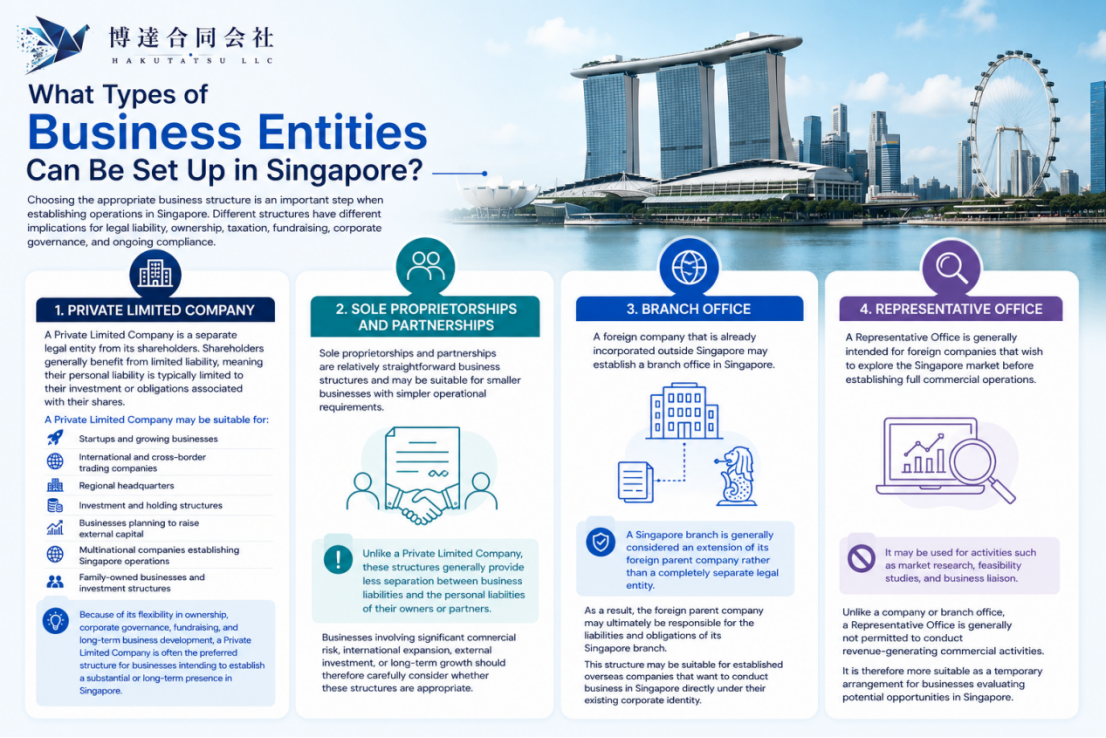
What Types of Business Entities Can Be Set Up in Singapore?Choosing the appropriate business structure is an important step when establishing operations in Singapore. Different structures have different implications for legal liability, ownership, taxation, fundraising, corporate governance, and ongoing compliance. Private Limited CompanyA Private Limited Company is one of the most commonly used business structures for foreign investors and international businesses establishing a presence in Singapore. It is a separate legal entity from its shareholders. Shareholders generally benefit from limited liability, meaning their personal liability is typically limited to their investment or obligations associated with their shares. A Private Limited Company may be suitable for:
Because of its flexibility in ownership, corporate governance, fundraising, and long-term business development, a Private Limited Company is often the preferred structure for businesses intending to establish a substantial or long-term presence in Singapore. Sole Proprietorships and PartnershipsSole proprietorships and partnerships are relatively straightforward business structures and may be suitable for smaller businesses with simpler operational requirements. Unlike a Private Limited Company, these structures generally provide less separation between business liabilities and the personal liabilities of their owners or partners. Businesses involving significant commercial risk, international expansion, external investment, or long-term growth should therefore carefully consider whether these structures are appropriate. Branch OfficeA foreign company that is already incorporated outside Singapore may establish a branch office in Singapore. A Singapore branch is generally considered an extension of its foreign parent company rather than a completely separate legal entity. As a result, the foreign parent company may ultimately be responsible for the liabilities and obligations of its Singapore branch. This structure may be suitable for established overseas companies that want to conduct business in Singapore directly under their existing corporate identity. Representative OfficeA Representative Office is generally intended for foreign companies that wish to explore the Singapore market before establishing full commercial operations. It may be used for activities such as market research, feasibility studies, and business liaison. Unlike a company or branch office, a Representative Office is generally not permitted to conduct revenue-generating commercial activities. It is therefore more suitable as a temporary arrangement for businesses evaluating potential opportunities in Singapore.
Which Singapore Business Structure Should You Choose?The appropriate business structure will depend on factors such as the nature of the business, shareholder profile, operational requirements, financing plans, tax considerations, regulatory requirements, and long-term objectives.For businesses planning to operate in Singapore over the long term, conduct cross-border activities, raise investment, or use Singapore as a regional platform for Southeast Asia and the wider Asian market, a Private Limited Company is often the most commonly considered structure. Smaller owner-operated businesses, companies with an established overseas headquarters, or businesses that are still evaluating the Singapore market may consider other structures, including sole proprietorships, partnerships, branch offices, or representative offices. Before proceeding with incorporation, businesses should carefully evaluate their proposed corporate structure, ownership arrangements, tax considerations, licensing requirements, and ongoing compliance obligations to ensure that the selected structure supports their commercial objectives.
|